
The nexus of health, well-being, and sustainability is reshaping healthcare priorities, urging an immediate shift toward sustainable practices for a resilient future.
Introduction
In an era where progress is measured not just in economic growth but in the vitality of our planet, a shift is underway. The intersection of health, well-being, and sustainability is no longer a mere crossroads. It is becoming a focal point globally. Gone are the days when health was a siloed fortress, well-being confined to treadmills, and sustainability an afterthought. Today, these once-disparate themes are converging, reshaping our understanding of holistic health. As the world orients towards a sustainable future, global entities are adjusting their priorities. The recent first-of-its-kind Health Day at COP28, led by the UAE presidency, signifies a major step in intertwining health and sustainability on the global stage. Recognizing the health crisis amid the climate crisis is paramount — the health sector, if considered a country, would rank as the 5th largest emitter of emissions.
In the insights that follow, HKx Associates explores the connection between health, well-being, and sustainability. Our research unravels the current state of affairs and anticipates a future where responsible health system practices and planetary well-being are inseparable. Join us as we explore the intricacies of sustainability as it relates to health, revealing not just its importance but its indispensability in shaping a healthier, more resilient future.

The Interplay of Healthcare and Sustainability
Across the healthcare sector, sustainability has traditionally been less of a focus area, especially when compared to other industries. Despite being altruistic in nature and saving billions of lives, healthcare continues to generate considerable waste and pollution. Corporate concerns about pollution, waste, and water use were minimal, evident in underreported sustainability efforts across major indices. Consumer interest in the sustainability of healthcare providers was also lacking compared to other sectors, e.g., consumers have shown to be conscious of emissions when purchasing airplane tickets. However, a shift is occurring. Sustainability in healthcare, once a sideline issue, is gaining prominence in the industry’s collective consciousness.
The intricate linkages between health and sustainability are now being recognized, with the inaugural COP28 Health Day including many discussions on topics such as delivering health to the last mile, improving health system resilience, and deploying advanced technologies for health sustainability. More importantly, the climate crisis is also being recognized as a health crises. A specific point of contention is the impact that health systems have on the environment, increasingly recognized through recent studies such as those published by The Commonwealth Fund and others. A prominent, negative feedback loop connects health systems, local environments and local populations. This is further exacerbated by broader, climate induced external pressures.
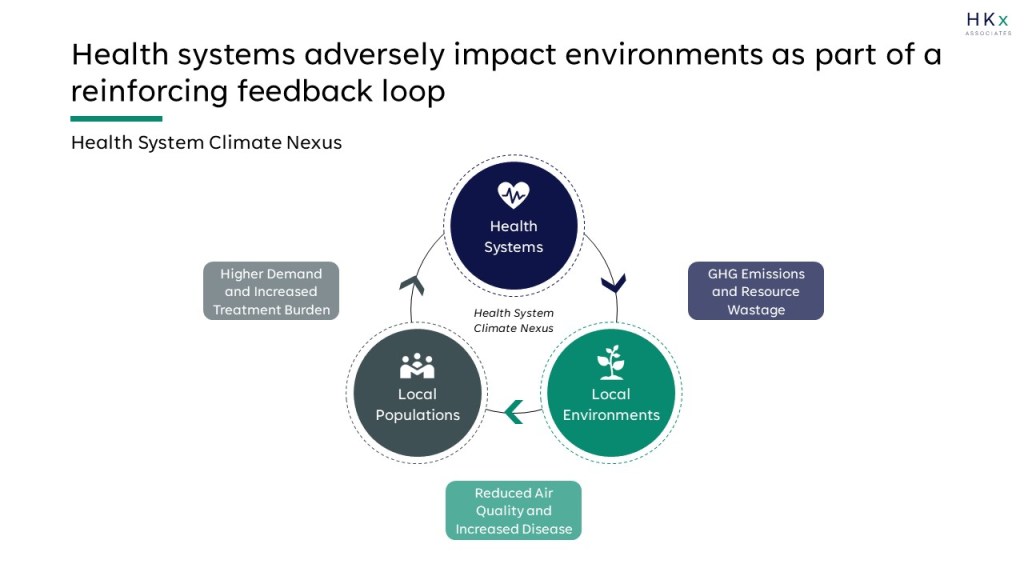
Health systems emit GHGs and generate healthcare waste, contributing to environmental degradation, compromising air quality and fostering disease. This, in turn, results in less healthy local populations, placing an increased burden on healthcare systems for treatment. Additionally, this negative cycle perpetuates itself as sicker populations lead to further health system impact on the environment. Our exploration underscores the urgency of understanding and addressing this intricate nexus, emphasizing the need for sustainable practices and policy interventions to break this cycle and foster a healthier, resilient future.
In addition to the health system climate nexus, health systems are being subjected to diverse climate-induced pressures, including extreme weather events, infectious diseases and food/ water insecurity. The World Health Organization forecasts an additional 5 million deaths worldwide between 2030 and 2050 due to climate induced impacts – namely, malnutrition, malaria, diarrhoea and heat stress. Now that we’ve grasped the connection between healthcare and sustainability, let’s uncover how health systems leave their mark on the environment.
Environmental Impacts of Health Systems
Hospitals are significant contributors to GHG emissions, emitting 2.5X more than other publicly funded buildings. Specifically in the U.S., in 2018, healthcare pollution led to the loss of ~388,000 disability-adjusted life years (DALYs) – the equivalent of years lost due to preventable medical errors. Globally, 4.6% of all GHG emissions are from the health sector, necessitating urgent review.
The overwhelming majority of these emissions (~70%) are classified as scope 3 – attributable to the health system supply chain. These include contributors such as gas, heat or cooling (also under scope 2), pharma and medical device manufacturing, IT services and supply chain elements. Due to the large proportion of scope 3 emissions, tackling the supply chain issue is critical. Scope 2 emissions (~13%) are also substantial – annually, the energy used to cool hospitals globally results in emissions equivalent to 110 coal-fired power plants. Scope 1 (~17%) emissions, although making up a smaller proportion of emissions, are also important to address as these fall directly under the remit of health systems. Notable examples include on-site boilers, medical gases and travel-related emissions (patients and staff).
In addition to emissions, health systems have a huge issue with waste. Recent global examples include $1B+ in pharmaceutical waste due to inadequate packaging and 200,000+ tonnes of COVID-19 related waste due to poor capacity planning. In addition, high-income countries produce double the amount of hazardous healthcare waste per bed at 11kg compared to low income countries at 6kg per bed. As we grapple with the profound environmental impacts of healthcare systems, the pressing need for a sustainable path forward is evident. From substantial GHG emissions to alarming volumes of healthcare waste, health systems, policy makers and regulators need to adopt novel measures to address these compounding issues.
A Path Towards Sustainable Health
For a truly sustainable health system, multiple topics need to be addressed, including efficient use of resources, emissions reductions, waste minimization, and the integration of eco-friendly practices across the entire supply chain. The biggest driver of emissions reduction would be to reduce scope 3 emissions – this requires a specific focus. A strategy specifically targeting scope 3 emissions may include;
- Tracking and reporting emissions data accurately for transparency
- Integrating ESG factors into the supply chain
- Implementing criteria for reduced/ zero emissions procurement
- Innovating with biodegradable materials and reusable packaging
Pharmaceutical companies are increasingly seeking sustainable energy sources – notably Novartis, GSK and Johnson & Johnson, Pfizer and Novo Nordisk all have renewable energy resources embedded within their sustainability strategies. On the policy front, Abu Dhabi’s Department of Health has set the ambition to achieve net zero across the health sector by 2050. Saudi Arabia is also taking steps to improve healthcare sustainability through reduced water and energy consumption. The US Department of Health and Human Services also launched the Health Sector Climate Pledge, which encourages health care organizations to commit to a goal of reducing GHG emissions by 50% by 2030 and achieving net zero emissions by 2050.
Whilst tackling emissions that health systems generate is important, reducing health system burden pressures as a whole is also something that should not be overlooked. For instance, healthcare providers across the spectrum (primary, secondary, tertiary) may employ preventive strategies to reduce the overall health system burden. Well-being promotion at the primary care level, proper screening and early detection at the secondary care level, and reducing comorbidities at the tertiary care level all present solutions to growing health system pressures. These can be coupled with advancements in technology that are driving solutions such as remote patient monitoring and telemedicine – which also may yield positive environmental impact.
The recent major health announcements at COP28 – including the declaration on climate and health signed by 120+ countries and the $1B allocated towards the climate-health crisis – demonstrate the increasing importance of sustainability in health and how this will be prioritized through the development of climate-resilient, sustainable, and equitable health systems.
Concluding Remarks
To conclude, our exploration into the relationship between healthcare and sustainability highlights the pressing need for transformative measures. From the environmental impact of health systems to the roadmap for sustainable healthcare, addressing these challenges requires innovative solutions. Recognizing the profound interconnectedness of health, well-being, and sustainability is crucial. Recent milestones, such as the groundbreaking Health Day at COP28 and global commitments to a climate-resilient future, emphasize the industry’s pivotal role. Embracing sustainable practices isn’t just advisable but rather a necessity for building a healthier, more resilient world.

